

News
Cutting-edge research in medical technology and vision science with spotlight on presbyopia research
Celebrating ten years of research and innovation on October 1st, Hochschule Furtwangen (HFU Research Center Rottweil) inaugurated a new ISO Class 7 cleanroom and welcomes insights into cutting-edge research in medical technology and vision science.
The Endowed Applied Vision Research Lab and the Centre for Ophthalmology at the University of Tübingen warmly congratulate Hochschule Furtwangen University (HFU) on the inauguration of its new cleanroom laboratory at the Research Center Rottweil, marking the center’s tenth anniversary.
The new ISO Class 7 cleanroom provides a controlled, low-particle environment for advanced research and development, particularly in medical technology. The facility offers new opportunities to explore innovative manufacturing processes and support the development of future medical technologies.
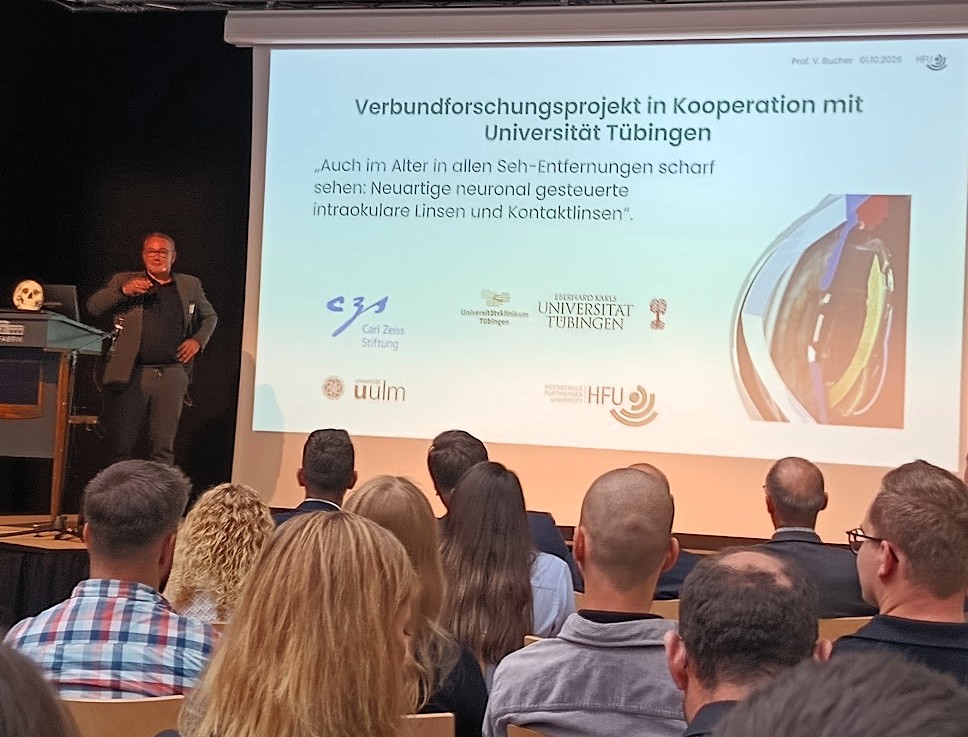
Among the invited guests was the Endowed Applied Vision Research Lab, which presented its research on presbyopia, an age-related loss of the eye’s ability to focus on nearby objects. During his presentation, Prof. Dr. Volker Bucher highlighted the common research project, funded by the Carl Zeiss Stiftung, as an example of innovative research combining vision science and biomedical engineering.
Presbyopia is a gradual, age-related decline in the eye’s ability to focus on objects at close range. In a young eye, the elastic crystalline lens changes shape through the action of the ciliary muscle, allowing vision to adapt between near and distant objects. As the lens becomes increasingly rigid with age, this accommodation mechanism progressively loses its effectiveness. Most people begin to experience noticeable difficulties with near vision between the ages of 40 and 50.
Although presbyopia is not a disease in the conventional sense, it can significantly affect everyday activities, independence, and quality of life. Reading glasses and contact lenses remain the most common ways to compensate for the loss of near vision. Surgical approaches involving intraocular lenses are also available, particularly in the context of cataract treatment. However, a technical solution that fully reproduces the dynamic accommodation mechanism of the young eye remains an important research goal.
Building on previous research at the Centre for Ophthalmology at the University of Tübingen, the project aims to develop biomimetic, wireless contact or intraocular lenses capable of mimicking the eye’s natural accommodation mechanism. It illustrates how fundamental insights into the physiology of vision can inform the development of future medical technologies.
The inauguration highlighted the importance of interdisciplinary collaboration in translating scientific discoveries into practical applications. The Endowed Applied Vision Research Lab and the Centre for Ophthalmology at the University of Tübingen congratulate HFU on this important milestone and look forward to further strengthening their collaboration and advancing innovative research together.
Bildunterschrift: Prof. Dr. Volker Bucher presents the collaborative research project with the Endowed Applied Vision Research Lab and the Centre for Ophthalmology at the University of Tübingen, focusing on innovative neuronally controlled intraocular and contact lenses to restore natural accommodation and enable clear vision at all distances, even in old age.