
Forschungsinstitut fuer Augenheilkunde
INSTITUTE FOR OPHTHALMIC RESEARCH
FORSCHUNGSINSTITUT FÜR AUGENHEILKUNDE

News

Innovative Research in Ophthalmology: New Approaches to Degenerative Retinal Diseases

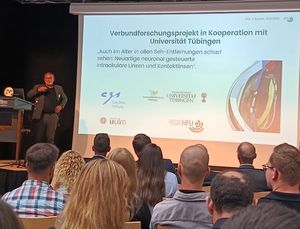
This article wants to summarize a recent interview with Marius Ueffing, Director of the Institute for Ophthalmic Research and Research Dean of the Faculty of Medicine at the University of Tübingen. The interview was conducted by Eyefox.

In this conversation, he outlines current research efforts, strategic priorities, and emerging therapeutic approaches aimed at tackling degenerative retinal diseases.

At the Institute for Ophthalmic Research in Tübingen, intensive efforts are underway to develop new diagnostic and therapeutic approaches for these conditions. A central focus lies on the close integration of basic research and clinical application, as well as on a strongly interdisciplinary approach.

Two major research consortia currently shape the institute’s work: the limits2vision project investigates fundamental mechanisms of retinal function, while RD TREAT is dedicated to developing targeted therapeutic strategies.

Understanding the Retina as a High-Performance System - the limits2vision Project

The retina is a highly complex and energy-demanding system that not only detects visual information but also processes it before transmitting it to the brain. Its ability to continuously adapt to changing environmental conditions while maintaining stable function over decades relies on a delicate balance between energy consumption and performance.

This is precisely where the international research project limits2vision comes in. Its goal is to understand the fundamental mechanisms that enable this long-term stability, and to determine why this system fails in diseases such as age-related macular degeneration or inherited retinal disorders.

A defining feature of the project is its close German-French collaboration with the renowned Institut de la Vision in Paris, one of Europe’s leading centers for vision research. Numerous research groups from both locations work together within a structured program that actively involves early-career researchers and promotes scientific exchange. The initiative is organized as an international graduate program.

On the German side, the project is primarily coordinated by Thomas Euler and François Paquet-Durand. While Thomas Euler focuses on the functional organization and complexity of the retina, François Paquet-Durand specializes in retinal energy metabolism and its role in degenerative processes.
Together, the participating scientists pursue an integrative approach: diverse data types, from imaging and electrophysiology to metabolic analyses are combined and analyzed using artificial intelligence. The aim is to develop a comprehensive mechanistic and systems-level understanding of the retina.
Beyond ophthalmology, the retina also serves as a model system to study fundamental principles of energy management in the central nervous system. Insights gained here may therefore have far-reaching implications beyond the field of vision research.

Focus on New Therapeutic Strategies – the RD TREAT Project

Building on these findings, the RD TREAT project aims to develop concrete therapies for retinal diseases that are currently difficult to treat. 

Three complementary approaches are being pursued in parallel:
Gene therapy: Further development of viral vectors to correct genetic defects, by Bernd Wissinger
Pharmacological approaches: Development of small molecules targeting disease-relevant signaling pathways, by Francois Paquet-Durand
Metabolic intervention: Regulation of cellular energy metabolism to reduce stress on photoreceptors, by Marius Ueffing

One particularly promising strategy involves deliberately reducing energy consumption in diseased retinal cells. Preclinical studies suggest that this can lower cellular stress and slow down, or even prevent the progression of degeneration.

Future Perspective: Combination Therapies and Personalized Medicine

In the long term, the Tübingen team is pursuing a paradigm shift: instead of relying on single-agent therapies, future treatments are expected to combine multiple approaches targeting different aspects of disease mechanisms, an approach that has already proven successful in other medical fields.

At the same time, biomarkers and disease progression patterns are being systematically analyzed to enable individualized treatment strategies. The final translational task to clinical studies will be implemented by Studienzentrale Auge und Ohr at the Department for Ophthalmology in Tübingen. The goal is to advance personalized medicine tailored to the diverse causes and manifestations of retinal diseases.

Research and Clinical Practice Under One Roof

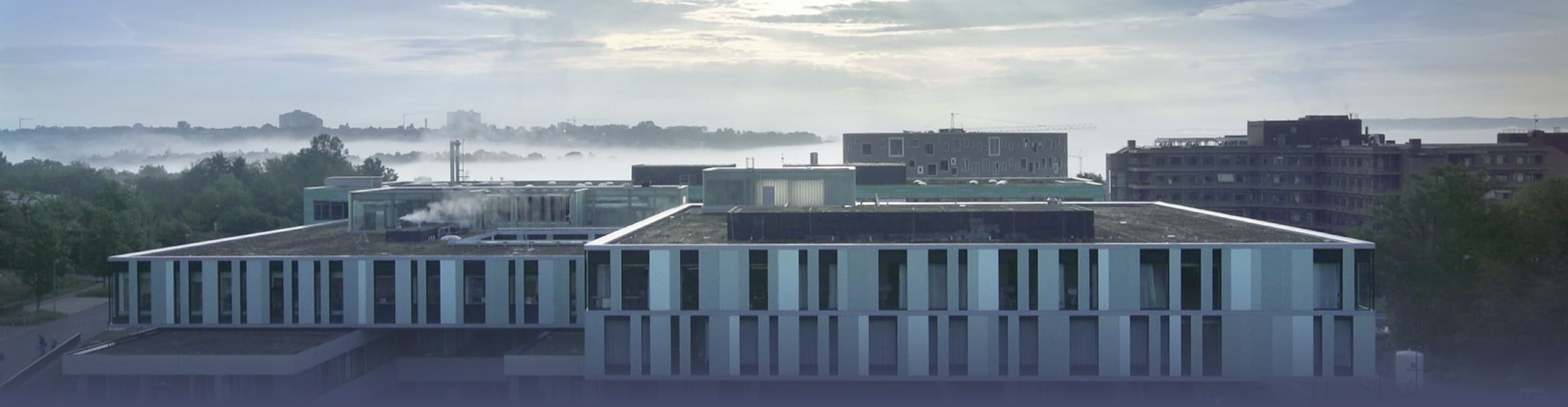
A distinctive feature of the Tübingen site is the close spatial and structural integration of research and patient care. This setup enables rapid translation of scientific discoveries into clinical studies and facilitates the direct testing of innovative therapies in patients.

Goal: Therapies for Previously Untreatable Diseases

Research in Tübingen pursues a clear objective: to create new diagnostic and therapeutic options for patients with degenerative retinal diseases. By combining interdisciplinary research, international collaboration, and technological innovation, the aim is to develop effective treatments that can prevent or significantly slow vision loss in the long term.

Link to the original interview, available only in German language: www.eyefox.com/videos/708/forschungsprojekte-zur-diagnostik-und-therapie-degenerativer-netzhauterkrankungen-prof-marius-ueffing.html

Bluesky

You can also follow us on @eye-tuebingen.bsky.social